

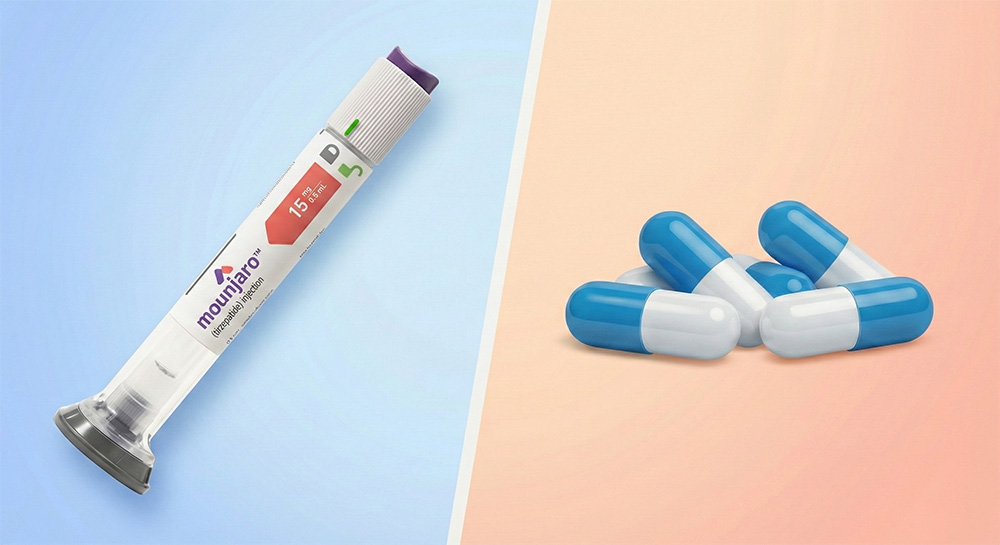
In 2026, the weight-loss pill landscape has changed in a serious way. Foundayo (orforglipron) was approved by the US FDA in April 2026 and is now available in the UAE. Oral Wegovy at the 25 mg weight-loss dose was approved in the US in December 2025 and is expected to be available in the UAE soon. Rybelsus and Qsymia remain as established oral options for their specific niches. Injectable GLP-1s still lead on average weight loss. Mounjaro (tirzepatide) sits at around 20% over six months at the top dose, and Wegovy (semaglutide) at around 12 to 15% over 12 months when paired with lifestyle support. The new pills sit slightly below the injectable semaglutide on the headline number. The decision is not ‘pills versus injections’ as a single answer. The right choice is matched to the patient’s phenotype, weight category, comorbidities, lifestyle, and the realistic chance of taking the medication consistently.
- Pills caught up dramatically in 2026, but injections still lead on average magnitude of weight loss.
- Foundayo and oral Wegovy are the new headline pills. Rybelsus and Qsymia have specific niches.
- Mounjaro and Wegovy remain the strongest GLP-1 injections, with deeper long-term outcome data.
- The right answer is decided by the medical picture, not by preference alone.
- Endocare prescribes from both sides of the comparison, in Dubai and Abu Dhabi.
What changed in 2026
Two events shifted the conversation. The first was the US FDA approval of oral Wegovy at the 25 mg dose in December 2025, the first oral semaglutide product licensed specifically for chronic weight management. The second was the FDA approval of Foundayo (orforglipron) in April 2026, a non-peptide GLP-1 pill from Eli Lilly that is taken once a day. Foundayo reached UAE pharmacies in May 2026 and is now prescribed at Endocare. For the first time, patients in the UAE asking ‘is there a real GLP-1 pill for weight loss’ have a regulated, on-label answer. The pill conversation is no longer hypothetical.
The pills explained
Foundayo (orforglipron)
A once-daily oral GLP-1 tablet from Eli Lilly. Foundayo is a small-molecule (non-peptide) GLP-1 receptor agonist, taken once a day with or without food and at any time of day, which is one of its convenience advantages over other oral GLP-1 medications. In the ATTAIN-1 Phase 3 trial in adults with obesity without type 2 diabetes, average weight loss at the highest dose was around 12%, with some patients losing up to 15%. Foundayo is approved by the FDA, available in the UAE, and prescribed at Foundayo at Endocare.
Oral Wegovy (semaglutide 25 mg)
A daily oral tablet of semaglutide at the 25 mg weight-loss dose. Approved by the US FDA in December 2025 for chronic weight management. Average weight loss in the OASIS programme sits in roughly the same family as the injectable Wegovy. It is not yet available in the UAE market, but is expected to be available in the UAE soon. See also the oral Wegovy update.
Rybelsus (semaglutide 7 mg / 14 mg)
A daily oral tablet of semaglutide at lower doses, licensed for type 2 diabetes. Rybelsus has been available in the UAE for some time, with a modest weight-loss effect of around 5 to 7%. It is not the same product as oral Wegovy. Patients cannot stack Rybelsus to replicate the oral Wegovy weight-loss dose, and dose escalation outside the licensed schedule is not safe.
Qsymia (phentermine and topiramate er)
A once-daily oral capsule that combines phentermine, an appetite suppressant, with extended-release topiramate. Qsymia is not a GLP-1 medication. It works on appetite and satiety through different pathways. Average weight loss is around 5 to 10%, useful as an alternative for patients who cannot tolerate GLP-1 medications or for whom GLP-1 medication is not clinically appropriate. Qsymia at Endocare is offered as part of the medical weight-loss programme, with a defined eligibility profile and its own monitoring plan. For the full prescribing reference, see the Qsymia prescribing information.
The injections explained
Mounjaro (tirzepatide)
A once-weekly injection that activates both GLP-1 and GIP receptors, the only dual agonist currently approved. In SURMOUNT-1, the pivotal Phase 3 trial in adults with obesity, average weight loss at the 15 mg dose was around 20% over 72 weeks. In real-world practice at Endocare, we commonly see significantly better outcomes than the published trial averages, around 15 to 20% weight loss, due to the combination of medication with structured lifestyle coaching. Mounjaro is the highest-magnitude option in the class today. Read more on Mounjaro at Endocare and tirzepatide as a molecule.
Wegovy (semaglutide)
A once-weekly injection of semaglutide, licensed for chronic weight management. Doses available in the UAE run from 0.25 mg up to 2.4 mg. Average weight loss in the STEP 1 trial was around 15% over 68 weeks when paired with lifestyle support. The active component in Wegovy (semaglutide) has been around for much longer than tirzepatide, so it has a deeper evidence base, including direct cardiovascular outcome data from the SELECT trial in patients with established cardiovascular disease and overweight or obesity. Read more on Wegovy at Endocare and semaglutide as a molecule.
Effectiveness compared, what the numbers actually say
The single table below summarises average weight loss across the main options. The figures come from each medication’s pivotal Phase 3 trial, with different study designs, durations, and patient populations. They are not direct head-to-head comparisons. They are useful as a frame, not as a promise.
| Medication | Form | Mechanism | Average weight loss | Notes |
|---|---|---|---|---|
| Mounjaro (tirzepatide) | Injection (weekly) | Dual GIP / GLP-1 | Around 20% at 6 months (top dose) | Highest magnitude in the class |
| Wegovy (semaglutide) | Injection (weekly) | GLP-1 | 12 to 15% at 12 months (with lifestyle) | Strong cardiovascular data (SELECT) |
| Oral Wegovy 25 mg | Pill (daily) | GLP-1 | Around 12 to 15% | FDA Dec 2025; UAE launch expected soon |
| Foundayo (orforglipron) | Pill (daily) | GLP-1 (small molecule) | Around 12% at top dose; up to 15% | UAE launch May 2026 |
| Rybelsus (semaglutide) | Pill (daily, 7 or 14 mg) | GLP-1 | Around 5 to 7% | Type 2 diabetes indication |
| Qsymia (phen/topiramate ER) | Pill (daily) | Appetite + satiety (non-GLP-1) | Around 5 to 10% | Alternative when GLP-1 is not suitable |
Read across the table, the honest picture is that the injectable side leads on the headline numbers, but the gap is narrower than it used to be. The pill is no longer a fall-back. It is a real choice for the right patient.
Side effects compared
All GLP-1 medications share the same broad side-effect profile, oral or injectable. The most common complaints are gastrointestinal: nausea, mild reflux, constipation, occasional diarrhoea, and reduced appetite, particularly in the first few days at a new dose. Not every patient experiences them. When they appear, they usually settle within the first 2 weeks at that step. The medication is built up gradually in conversation between the specialist and the patient.
- Less common but real: hair shedding linked to rapid weight loss and nutrient gaps; dehydration if intake drops sharply.
- Qsymia (non-GLP-1) has its own side-effect family: dry mouth, taste changes, tingling, sleep changes, mood effects, and contraindications in pregnancy.
At Endocare, side effects are managed actively. The toolkit includes dose adjustment, nutrition coaching, hydration, laboratory checks, and a switch to a different molecule if tolerability is a wall. Read more on the doctor-led medical weight-loss programme.
Medication cost at the UAE pharmacy
This section is about the medication price at the pharmacy, not the cost of any treatment package. Treatment packages are covered on each medication’s dedicated page.
- Mounjaro (tirzepatide): AED 1,734 per month at every dose, from 2.5 mg up to 15 mg. This is the unified Mounjaro medication price across the UAE.
- Wegovy (semaglutide injection): around AED 743.5 per month at the lowest dose (0.25 mg), rising to around AED 1,712 per month at the highest dose currently available in the UAE (2.4 mg).
- Rybelsus (oral semaglutide 7 mg or 14 mg): pharmacy price varies. Confirm with your pharmacy or at consultation.
- Foundayo (orforglipron): pharmacy price in the UAE is recent and should be confirmed at consultation.
- Qsymia (phentermine / topiramate ER): pharmacy price varies. Confirm with your pharmacy or at consultation.
Medication delivery from Endocare is free across the UAE, with same-day delivery in Dubai and within 48 hours nationwide. Endocare does not add markup to the official pharmacy price. Patients in Dubai can also explore the dedicated Wegovy in Dubai service page for delivery and consultation details specific to the city.
When the pill is the right answer
The patterns we see in clinic where an oral GLP-1 or other pill is the better recommendation include:
- Strong needle aversion that has previously stopped a patient from starting or continuing an injection.
- Travel-heavy lifestyles where a refrigerated pen is consistently difficult to manage.
- Patients in lower BMI ranges where the magnitude an oral GLP-1 delivers is enough to meet the medical goal.
- Patients stepping down from an injection who want a lighter, lower-burden form of continued support.
- Patients who tolerated semaglutide or tirzepatide poorly at higher injectable doses.
- Patients who cannot use GLP-1 medications at all, where Qsymia may be the practical option.
When the injection is the right answer
The patterns where an injectable GLP-1 is the responsible recommendation include:
- Higher BMI categories where the medical goal is the largest possible reduction in body weight.
- Type 2 diabetes with established cardiovascular disease, where injectable semaglutide has the deepest outcome data through the SELECT trial.
- Patients for whom adherence to a weekly injection has historically been easier than a daily tablet.
How Endocare matches medication to patient phenotype
Dr Hecham Harb’s consistent position in our patient education materials is that medication is matched to the patient’s phenotype and goals, not to preference alone. In practice, the decision in clinic is built on six inputs.
- Recent labs. Blood tests within the past three months covering HbA1c, fasting glucose, lipid profile, thyroid function, liver function, kidney function, and where relevant, hormonal panels.
- Body-composition analysis. Every patient gets a body-composition scan, included free of charge with every consultation, for every patient, on every visit. The scan informs both medication choice and lifestyle plan.
- Weight category and goal. BMI, the realistic medical target, and how much of the goal is about magnitude versus sustainability.
- Type 2 diabetes, pre-diabetes, cardiovascular history, polycystic ovarian syndrome, fatty liver, sleep apnoea, joint pain.
- Lifestyle realities. Travel patterns, work schedule, daily eating windows, ability to keep a once-daily pill schedule versus a once-weekly injection.
- Patient preference, taken seriously but not in isolation. Needle aversion is real. So is the desire for maximum effectiveness. The job is to balance both with the medicine.
Out of that conversation comes the recommendation. For some patients, Foundayo is the right answer. For others, it is Wegovy or Mounjaro. The next step is to book a medication-selection consultation.
Frequently asked questions
Is the Foundayo pill as effective as Mounjaro?
On average weight loss, no. Foundayo’s pivotal trial places average weight loss around 12%, with some patients losing up to 15%. Mounjaro at the top dose averages around 20% over six months. Foundayo can still be the right answer for the right patient (strong needle aversion, milder weight category, demanding travel schedule). The decision should be based on the full clinical picture, not on the headline number alone.
Is Rybelsus the same as Ozempic?
Both contain the same molecule, semaglutide, but they are different products. Rybelsus is a daily oral tablet at 7 or 14 mg, indicated for type 2 diabetes. Ozempic is a once-weekly injection available in the UAE in 0.25 mg, 0.5 mg, and 1.0 mg doses, also for type 2 diabetes. They are not interchangeable. Rybelsus has a more modest weight-loss effect than Ozempic.
Can I switch from my injection to a pill?
Only after a proper consultation. If you are doing well on Mounjaro or Wegovy, switching to a pill for convenience alone is rarely the right move. If injections have been a barrier (skipped doses, ongoing aversion, repeated logistical issues), an oral GLP-1 or Qsymia may be worth discussing. The switch should be planned, not improvised, in conversation with your specialist.
The 2026 landscape gives patients more options than ever, and gives endocrinologists a finer set of tools to match medication to person. The honest answer to ‘pill or injection’ is that it depends on the patient. The strongest options on average remain the injections. The pill is a real choice for a meaningful number of patients. If you would like an answer tailored to your own medical picture, the next step is a consultation. We prescribe from both sides of this comparison every day.
Book a medication-selection consultation at Endocare in Dubai or Abu Dhabi. The specialist will review your medical history, body-composition analysis, and goals, then recommend the option that fits your full clinical picture.
