

Fifteen kilos over three months works out at five kilos a month. That is faster than the three to four kilos a month our endocrinologists typically observe in clinic, and faster than the gradual rate of weight loss recommended by the US Centers for Disease Control and Prevention for maintaining weight loss. It may be achievable for some patients starting at a higher weight, where early weight loss is often faster.
- Fifteen kilos over three months is five kilos a month, above the three to four kilos a month our endocrinologists typically observe in clinic.
- The US Centers for Disease Control and Prevention states that people who lose weight at around 0.5 kg to 1 kg a week are more likely to keep it off.
- The pace is more achievable at a higher starting weight, because early weight loss is often faster.
- The NHS describes reducing daily calorie intake by around 600 calories as a safe and sustainable approach. A larger calorie deficit does not necessarily lead to better or more sustainable results.
- A study of 304 adults in Frontiers in Endocrinology found resistance training was the only form of exercise associated with an increase in fat-free mass during a calorie-restricted diet.
- Resting metabolic rate decreases as you lose weight, and a study in the International Journal of Obesity attributed around 40% of that decrease to metabolic adaptation.
- If you have a fixed date, tell your endocrinologist. Your endocrinologist can then build the plan around that date.
Five kilos a month is a demanding pace. It may be achievable for some patients, and the sections below explain what that pace involves and where the risks lie.
Is 15 kg in three months realistic?
For most people, it is not. For some patients, particularly those starting at a higher weight, it may be.
Endocare’s endocrinologists typically observe weight loss of three to four kilos per month in patients on a medically supervised programme. Five kilos a month is above that. The US Centers for Disease Control and Prevention states that people who lose weight at a gradual, steady pace of around 0.5 kg to 1 kg a week are more likely to keep it off than people who lose it faster. That makes five kilos a month a faster rate than generally recommended. Our article on whether you can lose 10 kg in a month explains why a faster pace than this is not realistic.
Starting weight is an important factor. A patient starting at 140 kg may lose faster in the first weeks than one starting at 85 kg, because a larger body uses more energy and early losses include more water. Your endocrinologist will assess your starting point before agreeing on a timeframe. Some patients start to see weight changes from around week two, while others take longer to respond. Early weight loss also does not necessarily continue at the same rate. Our article on how to lose 5 kg in a month covers what the first month usually looks like.
The risks of losing five kilos a month
Five kilos a month is an ambitious target, and how you lose the weight matters as much as the number itself. The usual approach involves a much larger calorie deficit, which is also where the risks become greater.
Muscle
Larger calorie deficits can increase the amount of lean tissue lost alongside body fat. A review in the journal Nutrients concluded that higher protein intakes protect fat-free and skeletal muscle mass during weight loss, and that they work either separately or together with exercise. A retrospective study of 304 adults on a calorie-restricted diet, published in Frontiers in Endocrinology, found that resistance training produced the greatest reduction in fat mass and was the only form of exercise associated with an increase in fat-free mass.
This is why the number on the scale is a poor judge of fast results. Two patients can lose the same 15 kg, one mostly as body fat and the other with several kilos of muscle included. At Endocare, body composition analysis is included free of charge at every consultation. It measures body fat percentage, visceral fat, skeletal muscle mass and body water, helping your endocrinologist track whether weight loss is coming from fat or lean tissue, something the scale alone cannot show.
Resting metabolic rate
Resting metabolic rate decreases as you lose weight, regardless of how quickly the weight is lost. A study in the International Journal of Obesity measured a decrease of around 101 calories a day in adults who lost around 8 kg over a year. It attributed roughly 60% of that decrease to the loss of energy-expending tissue and roughly 40% to metabolic adaptation.
One finding from the study is often reported in reverse. The researchers found no significant association between skeletal muscle loss and the reduction in resting metabolic rate, meaning that preserving muscle does not prevent this decline. Preserving muscle remains important for strength, physical function and maintaining a healthier body composition. Our article on protecting muscle while losing weight on a GLP-1 covers protein and training in more detail.
What a three month plan should look like
The plan we would build with you is one you can sustain for the whole three months. The NHS describes a reduction of around 600 calories a day as a safe and sustainable way to lose weight. A larger calorie deficit does not necessarily lead to proportionally greater weight loss and can become increasingly difficult to sustain over time.
Protein is the first thing your lifestyle coach will set. General guidance such as the International Society of Sports Nutrition suggests roughly 1.2 to 1.6 g per kg of body weight per day for people losing weight. Endocare’s lifestyle coaches will personalise that figure from your body composition analysis. Resistance training also matters. Two to three sessions a week can help preserve muscle during weight loss.
Measurement matters as well. Your endocrinologist will review your weight, your body composition analysis and your blood tests at monthly follow-up appointments, and adjust the plan from what those show. If you would prefer the same timeframe at a pace we would plan for, our article on how to lose 10 kg in 3 months sets out that approach.
Where medication changes what is achievable
In SURMOUNT-1, a Phase 3 clinical trial in adults with obesity or overweight, patients taking tirzepatide, the active ingredient in Mounjaro, at the highest dose lost an average of around 20% of their total body weight over 72 weeks. Importantly, this average weight loss was measured over 72 weeks, not three months.
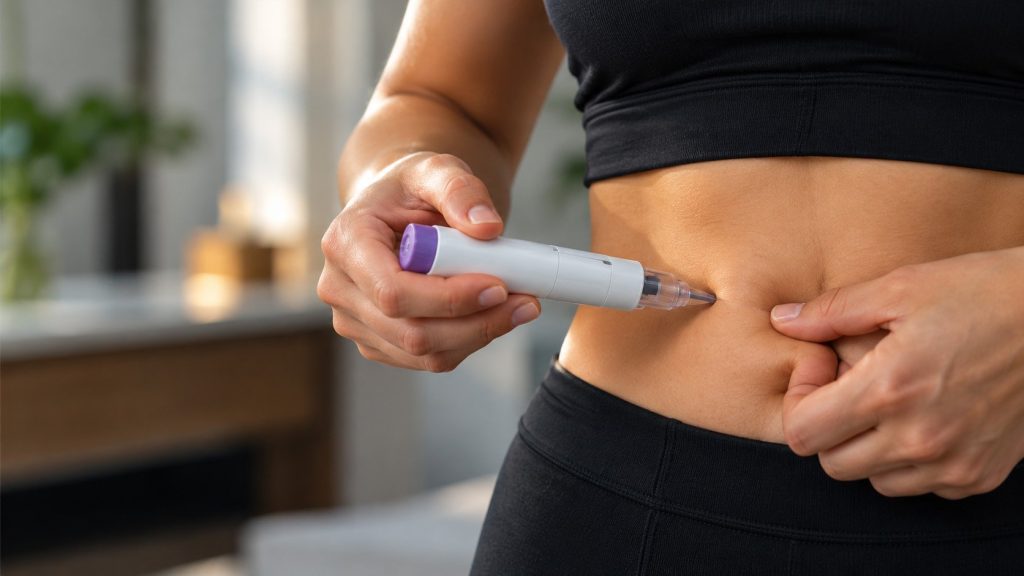
Where medication is clinically appropriate, the treatments prescribed at Endocare include the weight loss injections Mounjaro (tirzepatide), Wegovy and Ozempic, alongside the Wegovy pill and Foundayo (orforglipron), the once-daily oral GLP-1 tablet. Your endocrinologist will select between them from your assessment, and none of them is prescribed on request.
Our endocrinologists prescribe weight loss medication for patients with a body mass index above 30, or above 27 where there is a weight-related condition such as type 2 diabetes, hypertension or high cholesterol. The UK’s National Institute for Health and Care Excellence advises using lower thresholds, usually reduced by 2.5 kg/m2, for people from South Asian, Chinese, other Asian, Middle Eastern, Black African or African-Caribbean family backgrounds. That is relevant to a large share of patients in the UAE.
Patients should not decide by themselves to start a GLP-1 medication. A doctor’s review is critical to ensure the treatment is safe and appropriate for the individual.
Will losing 15 kg leave loose skin?
How much loose skin develops varies with factors such as age, starting weight, the amount of weight lost and skin elasticity. Some patients notice changes in skin firmness after losing 15 kg, while significant excess skin is more common after larger amounts of weight loss. Facial volume loss after weight loss is covered in our article on Ozempic face.
What 15 kg looks like on the body
Losing 15 kg can make a significant visible difference, but how much depends on your starting weight and body composition. The change will generally be more noticeable in someone starting at 75 kg than at 130 kg. What you lose also matters: losing mostly body fat will change your shape more than losing the same amount of weight with significant muscle loss.
If you have a deadline
Tell your endocrinologist the date at your first consultation. Knowing the date will affect what your endocrinologist recommends.
If your target and deadline do not match, your endocrinologist can discuss whether to adjust the target, extend the timeframe, or reassess the plan based on your response. If your target is larger, our article on how to lose 20 kg in 6 months sets out the longer timeframe.
Very restrictive approaches are also difficult to sustain and can increase the likelihood of weight regain.
Frequently asked questions
Is 15 kg in 3 months realistic?
For most people, it is not. Five kilos a month is above the three to four kilos a month our endocrinologists typically observe in clinic, and above the gradual rate the US Centers for Disease Control and Prevention recommends for maintaining weight loss. It may be achievable for some patients starting at a higher weight.
How long does it take to lose 15 kg?
At the three to four kilos a month we typically observe in clinic, 15 kg takes longer than three months for most patients. Your endocrinologist will give you a timeframe based on your starting weight and your test results.
Will losing 15 kg leave loose skin?
Some patients notice changes in skin tone or firmness after losing 15 kg, while significant excess skin is more common after larger amounts of weight loss. Losing weight gradually while preserving lean mass may also help support skin appearance.
What does a 15 kg loss look like?
Losing 15 kg can make a significant visible difference, but how much depends on your starting weight and body composition. The change will generally be more noticeable in someone starting at 75 kg than at 130 kg.
Is a bigger calorie deficit faster?
Not necessarily. The NHS describes reducing daily calorie intake by around 600 calories as a safe and sustainable approach. A larger calorie deficit can increase lean-mass loss and is generally harder to sustain over time.
Can medication get me there in three months?
Your endocrinologist will not promise a date. In SURMOUNT-1, patients taking tirzepatide at the highest dose lost an average of around 20% of their total body weight over 72 weeks. Whether the treatment is a weight loss injection such as Mounjaro or Wegovy, or a tablet such as Foundayo, your endocrinologist will assess whether medication is appropriate for you and plan it over the long term.
If you want to lose 15 kg by a particular date, the first step is a consultation. Your endocrinologist will assess your starting point, review your blood tests and your body composition analysis, and advise you on what is realistic within that timeframe.
You can talk to an endocrinologist at our clinics in Dubai and Abu Dhabi.
