

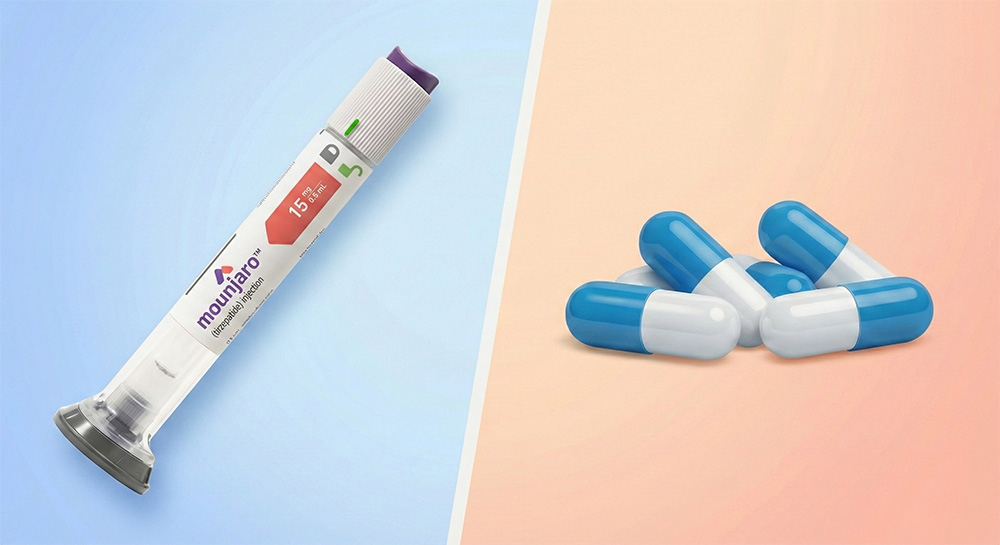
Choosing between weight loss injections vs pills often sounds like a simple comparison, but it usually isn’t.
These options can work through different pathways, come with different routines, and suit different medical needs.
At the most basic level, the difference lies in how the medication enters the body. Weight loss injections are administered via subcutaneous injection, while weight loss pills are taken orally and absorbed through the digestive system. This distinction affects how the medication is absorbed, how consistently it works, and how it fits into a person’s daily routine.
That’s why the most useful starting point is not “which is better,” but which is more appropriate for you based on safety, tolerability, and how your body responds over time.
It also helps to be clear about what’s being compared. “Injections” and “pills” are broad labels that include different medications, doses, and monitoring requirements.
As a result, outcomes can vary widely from person to person, even when two people choose the same route.
This guide breaks down the differences in a neutral, clinical way so you can understand the core medical weight loss options and discuss them confidently within a medical weight loss programme.
What “Weight Loss Injections” Usually Refer To?
When people talk about weight loss injections, they are usually referring to prescription injectable medications used within a medically supervised weight loss setting.
These treatments are not cosmetic or short-term tools; they are part of structured care designed to support appetite regulation and eating behaviour over time.
Most modern injectable options used in this context act on hormonal pathways involved in hunger and satiety. Rather than “forcing” weight loss, they influence how full a person feels, how quickly hunger returns, and how the body responds to food intake.
This is why outcomes can differ significantly between individuals. The medication itself does not determine results in isolation, the body’s response to it does.
In clinical practice, these injections are often grouped under GLP-1 injections such as Mounjaro and Ozempic, although this category includes multiple formulations and dosing approaches.
The goal is not rapid weight change, but improved appetite control that can be maintained alongside nutrition, lifestyle adjustments, and monitoring.
For patients considering injectable weight loss options in Dubai, supervision matters. Injections are typically started at lower doses and adjusted gradually based on tolerance, appetite response, and side effects.
Importantly, injectable medications are not appropriate for everyone. Medical history, existing conditions, and individual tolerance all influence whether this route is considered suitable.
This is why injections are evaluated as one option among several, not as a default or superior choice.
What “Weight Loss Pills” Actually Include?
In Dubai, currently available prescription weight loss pills include a limited number of oral medications with differing mechanisms of action.
Some act on appetite regulation through the central nervous system, while others affect fat absorption in the digestive tract. These options are prescribed selectively and always within a doctor-supervised setting.
Compared to injectable treatments, most oral weight loss medications used at present tend to produce more modest and less consistent appetite suppression. This is largely due to differences in absorption and how reliably therapeutic levels are maintained in the body.
For this reason, pills are generally considered less effective than injections in current clinical practice, although individual response can vary.
Oral medications also require daily dosing, which introduces an adherence factor. Missed doses, digestive tolerance, and timing with food can all influence outcomes over time.
It is important to distinguish current options from emerging treatments.
Oral GLP-1 medications, often referred to as Wegovy pills, are not yet widely available for weight loss in the UAE but are expected to become an option in the near future. These newer formulations aim to offer efficacy closer to injectable GLP-1 treatments, pending real-world clinical use and availability.
Injections VS Pills: Practical Differences
| Aspect | Weight loss injections | Weight loss pills |
| Route of administration | Delivered via a small subcutaneous injection, usually self-administered following clinical instruction. | Taken orally as tablets or capsules, swallowed according to prescribed guidance. |
| Dosing pattern | Often prescribed on a weekly schedule, depending on the medication and individual response. | Typically taken daily, sometimes with specific timing or dietary instructions. |
| Absorption and consistency | Absorbed directly through the subcutaneous tissue, which can lead to more consistent drug delivery. | Absorption occurs through the digestive system and may be influenced by food timing, digestion, or adherence. |
| Monitoring requirements | Requires regular clinical review to assess appetite response, tolerance, and side effects over time. | Also requires monitoring, particularly to assess gastrointestinal tolerance, adherence, and effectiveness. |
| Side effect profile | Gastrointestinal effects are common, especially during early dose phases; injection-site reactions may occur in some individuals. | Gastrointestinal side effects are also common; injection-site reactions are not applicable. |
| Lifestyle fit | Suits individuals comfortable with injections and a less frequent dosing routine. | May suit those who prefer tablets and are able to maintain consistent daily dosing. |
Available Options In Dubai
In the UAE, doctor-supervised weight loss programmes currently use a limited range of prescription medications.
Injectable GLP-1 treatments such as Mounjaro (tirzepatide), Wegovy, and Ozempic are available through licensed clinics and pharmacies for eligible patients and are commonly used due to their consistent appetite-regulating effects.
By contrast, oral weight loss pills for obesity management are limited in the UAE at present.
While some oral medications are prescribed under medical supervision, their effects are generally more modest compared to injectable options, depending on formulation and individual response.
Effectiveness in Current Clinical Practice
In current clinical practice, injectable treatments are generally associated with more consistent and pronounced appetite regulation than oral weight loss medications.
This is largely due to steadier absorption and more predictable therapeutic levels over time.
While injections are currently considered more effective overall in clinical settings, individual response, tolerance, and long-term adherence remain central to treatment success.
Emerging Oral GLP-1 Options
Oral GLP-1–based treatments are an evolving area of medical weight loss.
Oral semaglutide formulations, often discussed as “Wegovy pills,” are not yet widely available for weight loss in the UAE but are expected to become part of clinical practice in the near future.
These oral options aim to deliver similar mechanisms of action to injectable GLP-1 treatments, with the convenience of tablet-based dosing.
While early data suggests promising efficacy, real-world outcomes and tolerability will continue to guide how these medications are integrated into treatment plans once available.
As these options emerge, clinicians will assess their role alongside existing injectable treatments, rather than viewing them as direct replacements.
Side Effects And Tolerance: Why Monitoring Matters?
All prescription weight loss medications, whether injectable or oral, can cause side effects, and these vary depending on the medication, dose, and individual response.
Gastrointestinal symptoms such as nausea, changes in bowel habits, or reduced appetite are commonly reported with both injections and pills. These effects often appear during the initial weeks or following dose adjustments, when the body is adapting.
Importantly, experiencing side effects does not automatically mean a treatment is unsuitable, just as the absence of side effects does not guarantee effectiveness.
In clinical practice, tolerance is evaluated over time.
The goal is not to “push through” discomfort, but to assess how well side effects are managed alongside appetite regulation and daily functioning. For injectable treatments, local reactions at the injection site may occur in some individuals, while oral medications may present challenges related to digestion or absorption.
Side effects play a central role in treatment decisions. They help guide whether a dose should be maintained, adjusted, or reconsidered altogether. This is why monitoring is not a formality, but a core part of responsible care, ensuring that treatment remains both safe and sustainable.
How Clinicians Decide Which Option May Be Appropriate
Choosing between injections and pills is not about identifying a universally superior option. Instead, clinicians assess a combination of medical, practical, and individual factors to determine which approach may be most appropriate within a doctor-supervised weight loss plan.
Medical history is a primary consideration. Existing conditions, current medications, and known contraindications can influence whether certain treatments are suitable.
For some individuals, specific oral medications may not be advised, while others may not be ideal candidates for injectable therapies.
Tolerance is another key factor. How a person responds to side effects, particularly during the early stages, provides valuable insight into whether a treatment can be continued safely.
Clinicians also consider how appetite regulation evolves over time, rather than focusing solely on short-term changes.
Finally, ongoing monitoring ties these elements together.
Treatment decisions are reviewed regularly, with adjustments made based on response, tolerance, and overall health. This structured approach is central to responsible medical weight loss options ensuring that care remains personalised rather than protocol-driven.
Conclusion
Comparing injections and pills can be helpful, but the decision is rarely about finding a universally “better” option. Both routes sit within the same category of medical weight loss options and are selected based on how an individual’s body responds, how side effects are tolerated, and how well the treatment fits into daily life.
What matters most is supervision. Weight loss medications work best when they are prescribed, monitored, and adjusted over time, rather than approached as short-term solutions. This is why decisions around treatment are made collaboratively, with regular review and flexibility built in.
If you’re considering prescription support, discussing options within a doctor-supervised weight loss plan helps ensure care remains safe, appropriate, and sustainable.
Frequently Asked Questions
Which is better: weight loss pills or injections?
There is no single answer. The choice depends on medical history, tolerance to side effects, dosing preferences, and how the body responds. For some people, injections may be suitable; for others, oral treatment may be more appropriate. This is why comparisons focus on suitability rather than outcomes.
Is there a weight loss pill instead of injections?
Yes, oral weight loss medication is available, but pills and injections work through different mechanisms and require different routines. Pills are not a replacement for injections in all cases, and eligibility depends on individual health factors and clinical guidance.
Are injections more effective than tablets?
In some studies, injectable treatments show more consistent absorption, but this does not automatically translate into better results for everyone. When comparing weight loss injections vs tablets, effectiveness depends on adherence, tolerance, and ongoing monitoring rather than the route alone.
How do clinics decide between injections and pills?
Clinicians consider several factors, including medical history, contraindications, side effect tolerance, and whether a person is more likely to adhere to daily tablets or less frequent injections. At Endocare, this evaluation is part of a structured process designed to support long-term care rather than quick decisions.
Can I switch between pills and injections later?
Switching may be possible, but only under medical supervision. Changes are usually based on side effects, tolerance, or evolving treatment needs. Clinics such as Endocare assess these decisions carefully to ensure continuity and safety rather than reactive changes.
