

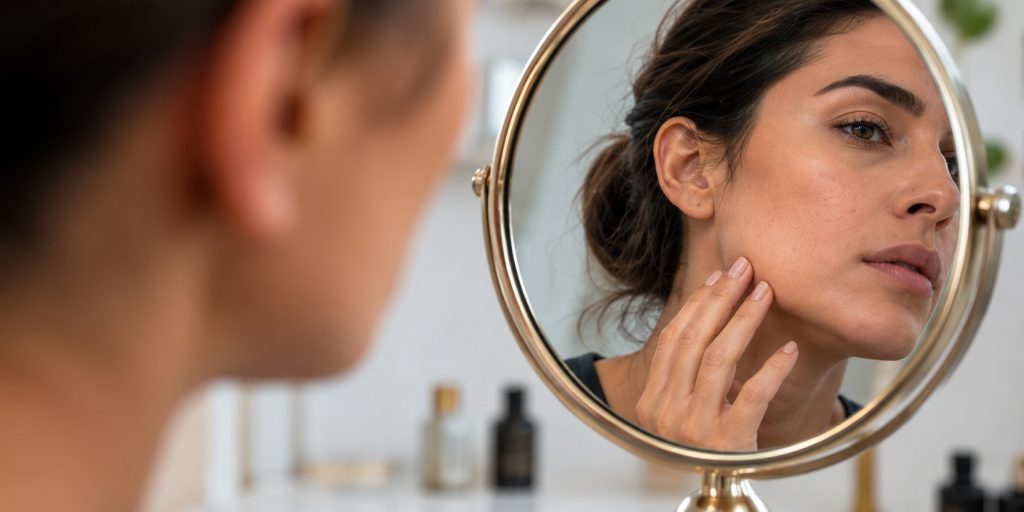
Ozempic face describes the sunken cheeks, hollow temples and looser skin that some patients notice after fast weight loss on a GLP-1 medication. It is not considered a direct effect of the medication. Fat can be lost from the facial compartments faster than the skin adapts, and similar changes are reported after any rapid weight loss, including bariatric surgery. How quickly you lose weight is one of the main factors that can influence how noticeable these facial changes are.
- Ozempic face describes an appearance. It is not a medical diagnosis, and no prescribing information lists it as a side effect.
- The Cleveland Clinic states that the change is a consequence of rapid weight loss and not of the medication itself.
- A systematic review in the Aesthetic Surgery Journal Open Forum found the midface changes most, through flattening of the cheek and deepening of the folds beside the nose.
- Similar facial changes are reported after bariatric surgery and after rapid weight loss without any medication.
- How quickly you lose weight can influence how noticeable the facial changes are. Adequate protein and resistance training remain important during weight loss to help preserve muscle.
- At Endocare, body composition analysis is included free of charge at every consultation, so your endocrinologist can see whether you are losing fat or lean tissue.
- Some facial volume may return if weight is regained, and skin laxity may improve gradually after weight stabilises.
Facial volume loss is a common concern among patients considering or using a GLP-1 medication. The change is real and well described after substantial weight loss.
What is Ozempic face?
Ozempic face is an informal term for the appearance of sunken cheeks, hollow temples, deeper folds beside the nose and looser skin along the jaw and under the chin, seen after substantial weight loss. It is not a diagnosis and it does not appear in any prescribing information.
The term became attached to one brand because that brand received the most public attention. Similar facial changes have long been described after substantial weight loss, including after bariatric surgery.
What causes the change in your face
Fat loss in the facial compartments
The face stores fat in separate compartments, and those compartments do not all lose volume at the same rate. A systematic review of fourteen studies in the Aesthetic Surgery Journal Open Forum examined facial changes after major weight loss from both surgical and medical treatment. It found that midfacial volume loss is the most significant change. This shows as flattening of the cheek and deepening of the folds that run from the nose to the corner of the mouth, followed by loosening of the skin under the chin.
A retrospective study in the Aesthetic Surgery Journal tracked these compartments on repeat scans. It found that the hollow at the temple comes mainly from thinning of the superficial temporal fat, and that downward movement of the cheek fat pad deepens the fold beside the mouth. That study examined facial ageing rather than weight loss, but the same compartments are involved. That may be one reason the temple and the cheek are often the first regions patients notice.
Skin that does not shrink as fast as the fat
Fat volume can fall over weeks. Skin adapts more slowly, often over months, and how much it adapts can depend on your age, how long you carried the weight and the elasticity you started with. When the volume beneath the skin falls faster than the skin can retract, the result can be the looser appearance the term describes.
Is Ozempic face caused by the medication itself?
No. The Cleveland Clinic states that the change is not a side effect of the medication and is a consequence of the rapid weight loss the medication can produce. The FDA-approved prescribing information for Wegovy lists no facial effect among the adverse reactions. Our page on Ozempic side effects covers the reactions that are listed.
Similar facial changes can occur after rapid weight loss from bariatric surgery or lifestyle changes, supporting that the change is related primarily to weight loss rather than a direct effect of the medication. The Cleveland Clinic notes the same pattern after bariatric surgery and after lifestyle changes that produce very rapid loss.
The change is not specific to Ozempic and can also occur with weight loss on Mounjaro, Wegovy and other weight loss treatments.
Who is most likely to notice facial changes
Changes are often more noticeable in patients who lose weight quickly. Age and skin elasticity can also affect how noticeable the changes are, as skin naturally loses collagen and elasticity over time. Our article on whether you can lose 10 kg in a month explains why a very fast pace is not recommended.
Starting weight also matters. Losing 12 kg from 75 kg represents a much larger proportion of total body weight than losing 20 kg from 140 kg, so the visible change may be more noticeable.
Can you avoid Ozempic face while still losing weight?
Not entirely. Losing body fat includes losing facial fat. Several factors can influence how noticeable the change is, and none of them involves stopping treatment.
The rate of weight loss
The Cleveland Clinic recommends aiming for gradual loss of around half a kilo to one kilo a week. Our endocrinologists typically observe weight loss of three to four kilos per month in patients on a medically supervised programme, which is within that range.
If your weight is falling faster than expected and facial changes concern you, raise this at your next follow-up. Your endocrinologist can review your rate of weight loss, treatment response and current dose with you. Do not reduce your own dose. Your endocrinologist will make dose decisions with you at your monthly follow-up appointment.
Protein and resistance training
A review in the journal Nutrients concluded that protein intakes above the standard 0.8 g per kilogram guideline protect fat-free and skeletal muscle mass during weight loss. The review found this whether protein was used on its own or together with exercise. A retrospective study of 304 adults on a calorie-restricted diet, published in Frontiers in Endocrinology, found that resistance training produced the greatest reduction in fat mass. It was also the only form of exercise associated with an increase in fat-free mass.
General guidance such as the International Society of Sports Nutrition suggests roughly 1.2 to 1.6 g per kg of body weight per day for people losing weight. Endocare’s lifestyle coaches will personalise that figure from your body composition analysis. The same applies to muscle loss on a GLP-1 elsewhere in the body.
What body composition analysis shows that the scale cannot
At Endocare, body composition analysis is included free of charge at every consultation. It measures body fat percentage, visceral fat, skeletal muscle mass and body water, helping your endocrinologist track whether weight loss is coming from fat or lean tissue, something the scale alone cannot show.
Two patients losing four kilos a month can have very different skeletal muscle readings. Losing mostly body fat generally produces a better result than losing the same amount of weight with significant muscle loss.
Does Ozempic face go away?
Partly, and the two components behave differently. Some facial volume may return if weight is regained.
Skin laxity may improve gradually after weight stabilises, although how much it improves varies depending on factors such as age and skin elasticity.
What treatments are available if the change bothers you
Endocare does not perform aesthetic procedures, so what follows describes the options and does not recommend them. Dermal fillers can restore volume temporarily. Energy-based skin tightening is offered for laxity. Surgical options exist for significant excess skin after very large weight loss. Our article on how to lose 15 kg in 3 months covers loose skin after a larger loss.
Before any of that, we recommend a conversation about your rate of weight loss and your body composition results. An aesthetic procedure addresses the appearance at one point in time while your weight is still changing.
How Endocare approaches this with patients
Your endocrinologist will review your weight, your body composition analysis and your side effects at each monthly follow-up appointment, and you can raise facial and skin changes at any of them. Where the rate of weight loss is faster than intended, your endocrinologist can review your treatment response and current dose with you at that appointment.
Where medication is clinically appropriate, the treatments our endocrinologists prescribe include the weight loss injections Mounjaro (tirzepatide), Wegovy and Ozempic, alongside the Wegovy pill and Foundayo (orforglipron), the once-daily oral GLP-1 tablet. Patients should not decide by themselves to start a GLP-1 medication. A doctor’s review is critical to ensure the treatment is safe and appropriate for the individual.
Frequently asked questions
Does Ozempic face go away?
Some facial volume may return if weight is regained, and skin laxity may improve gradually after weight stabilises. How much it improves varies depending on factors such as age and skin elasticity.
Is Ozempic face permanent?
Generally not. The appearance may be more noticeable while weight is falling quickly and can improve after weight stabilises.
Can you prevent Ozempic face while still losing weight?
Not entirely, because losing body fat includes losing facial fat. How quickly you lose weight can influence how noticeable the changes are, and adequate protein and resistance training can help preserve muscle during weight loss.
Does Mounjaro cause the same facial changes?
Yes. Similar facial changes can occur with substantial weight loss on Mounjaro and with weight loss without medication, so the effect is not considered specific to Ozempic.
Does losing weight more slowly help?
The Cleveland Clinic recommends gradual loss of around half a kilo to one kilo a week and describes slower loss as less likely to accelerate the appearance of facial ageing. We recommend discussing your rate of weight loss with your endocrinologist.
Is Ozempic face a medical diagnosis?
No. It is an informal description of an appearance. It does not appear in any prescribing information and it is not a recognised adverse effect of semaglutide or tirzepatide.
If your weight is coming off faster than you expected, or the change in your face concerns you, the next step is a follow-up appointment. Your endocrinologist will review your body composition analysis and discuss the pace of your treatment.
You can speak to an endocrinologist at our clinics in Dubai and Abu Dhabi.
