

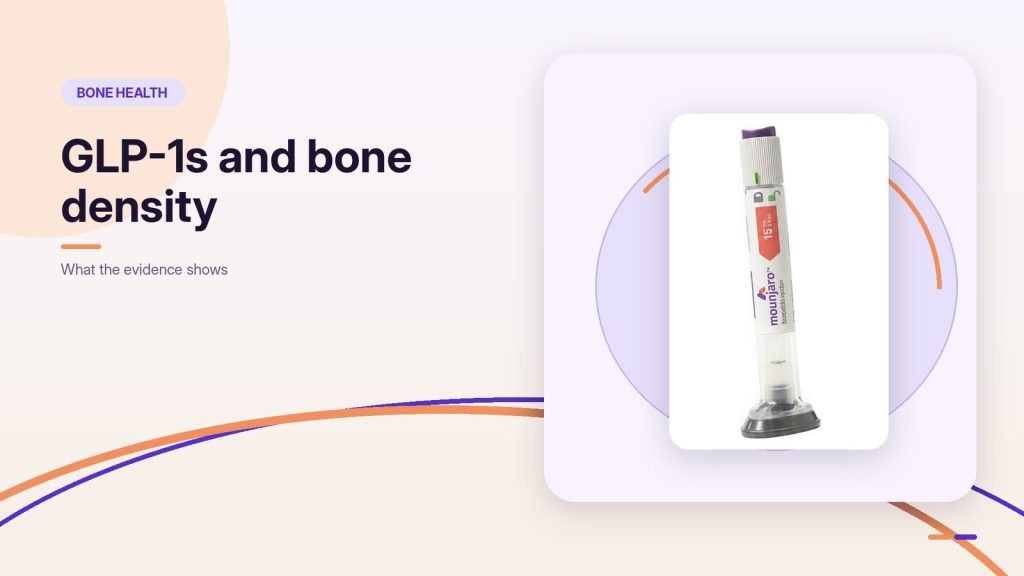
Some studies have observed changes in bone density during GLP-1 treatment, but it is not yet clear how much is due to the medication rather than weight loss itself. A 2025 review in Osteoporosis International calls the evidence limited, particularly for fractures. In one trial, exercise combined with liraglutide, an older GLP-1 medication, was linked to no greater bone loss than placebo. Your endocrinologist can assess whether you have risk factors that warrant further bone-health checks.
- A 2025 review in Osteoporosis International links a weight loss of around 7% to 10%, whether through diet or surgery, with bone loss.
- In a one-year trial in adults with obesity, those taking liraglutide alone lost more bone density at the hip and spine than those taking a placebo.
- In the main heart trial reported in the Wegovy injection’s US label, 1% of women taking it had a hip or pelvis fracture, against 0.2% of women taking a placebo.
- A US records study linked GLP-1 medication use in adults with type 2 diabetes and obesity with a higher five-year rate of osteoporosis, at 4.1% against 3.2%.
- A Danish study of more than 337,000 people with fractures linked GLP-1 medication use with slightly lower odds of a major osteoporotic fracture.
- NHS advice for protecting bone density centres on weight-bearing and resistance exercise, calcium and vitamin D.
- Endocare’s endocrinologists manage osteoporosis as well as weight, and can review your bone health as part of your treatment plan.
Do GLP-1 medications affect bone density?
Bone density reflects how much mineral the bones contain. Lower bone density is associated with a higher risk of fractures.
A 2025 review in Osteoporosis International found that the evidence on GLP-1 medications and bone in people with obesity is limited. The early findings suggest a slight reduction in bone density, with a pattern of bone turnover similar to that seen with weight loss from calorie restriction. The authors call for more research on fracture risk.
Why weight loss can affect your bones
The same review reports that losing around 7% to 10% of body weight through calorie restriction, with or without exercise, or through bariatric surgery, is associated with bone loss. Losing weight very quickly can also mean losing bone density, along with muscle and water.
The effect of a GLP-1 medication on bone is therefore difficult to separate from the effect of the weight loss that comes with treatment.
What the trials and studies show
In a trial of 195 adults with obesity, published in JAMA Network Open in 2024, participants first lost weight on a low-calorie diet. They then received exercise, liraglutide, both or a placebo for a year. Liraglutide is an older GLP-1 medication taken once a day.
Participants taking liraglutide alone had a greater fall in hip and spine bone density than those taking a placebo. Participants who combined liraglutide with exercise had no greater bone loss than the placebo group.
In the United States, the prescribing information for the Wegovy injection describes hip and pelvis fractures in its main heart trial. Women taking the Wegovy injection had more of these fractures than women taking a placebo, at 1% against 0.2%. Among adults aged 75 or older, the figures were 2.4% and 0.6%.
A US records study reported by the American Academy of Orthopaedic Surgeons compared 73,483 adults with type 2 diabetes and obesity taking GLP-1 medications with the same number of similar adults who were not. Over five years, 4.1% of the GLP-1 group developed osteoporosis, against 3.2% of the comparison group. The authors describe this as an association that does not prove cause and effect, with modest absolute risks.
A Danish study published in Osteoporosis International in 2026 compared 337,648 people who had a fracture with 675,296 people who had not. In that study, GLP-1 medication use was associated with slightly lower odds of a major osteoporotic fracture.
The two studies reached different conclusions. Because both are observational, neither can show whether the medication itself changed the risk.
Does Ozempic or Mounjaro affect bone density?
Ozempic contains semaglutide, the same active ingredient as the Wegovy injection, and is used at lower doses. The Wegovy pill also contains semaglutide, and the Emirates Drug Establishment approved it in the UAE in June 2026. Ozempic is approved for type 2 diabetes, and Wegovy is the semaglutide medication approved for weight management. At Endocare, Ozempic is considered for weight management only in patients with type 2 diabetes or prediabetes. Ozempic is not approved for weight management or for prediabetes, so using it for weight management outside the treatment of type 2 diabetes, including in prediabetes, is off-label.
Mounjaro contains tirzepatide. The Zepbound prescribing information, the US label for tirzepatide in weight management, includes no warning about bone density or fractures. Neither does the Foundayo prescribing information.
The absence of a warning does not mean that an effect on bone has been ruled out. Research on bone with the newer GLP-1 medications is still limited.
Who may need closer attention to bone health?
The Wegovy label findings suggest that women and adults aged 75 or older may need particular attention to bone health during treatment. Bone density can also fall after the menopause.
If you have osteoporosis, a previous fracture or a family history of osteoporosis, we recommend telling your endocrinologist before you start treatment.
How to protect your bones during weight loss
The NHS describes weight-bearing and resistance exercise as particularly important for improving bone density. It recommends muscle-strengthening activity on two or more days a week.
The NHS recommends 700 mg of calcium a day for adults, and 10 micrograms of vitamin D a day. It also associates smoking with osteoporosis and advises keeping alcohol within 14 units a week.
Adequate protein and resistance training can help preserve muscle while you lose weight. Endocare’s lifestyle coaches can help you plan enough protein and calcium-rich foods while your appetite is lower. Our articles on exercise on weight loss injections and GLP-1 medications and muscle loss explain how to approach training and muscle.
How Endocare looks after bone health during weight loss
Alongside weight management, Endocare’s physicians manage osteoporosis related to hormonal changes. The clinical expertise of Dr Hecham Harb, Medical Director and Consultant Endocrinologist, includes the management of osteoporosis and metabolic bone diseases.
Your endocrinologist will review your fracture history, your risk factors for osteoporosis and your blood tests before recommending treatment. They can also advise whether a bone density scan is appropriate for you. Patients should not decide by themselves to start a GLP-1 medication. A doctor’s review is critical to ensure the treatment is safe and appropriate for the individual.
At Endocare, body composition analysis is included free of charge at every consultation. Body composition analysis estimates body fat, muscle mass and body water. Repeated measurements help your endocrinologist understand how your body is changing beyond the number on the scale.
Frequently asked questions
Does Ozempic cause bone loss?
It may contribute to a small loss of bone density, possibly through the weight loss itself. Ozempic contains semaglutide. In the main heart trial of the Wegovy injection, which contains the same active ingredient, women and adults aged 75 or older had more hip and pelvis fractures than those taking a placebo.
Does Mounjaro affect bone density?
There is little research on tirzepatide, the active ingredient in Mounjaro, and bone density. Its US label for weight management carries no bone or fracture warning. Weight loss from any cause can be associated with some bone loss, so exercise, protein, calcium and vitamin D remain important.
Should I take calcium and vitamin D on a GLP-1 medication?
The NHS recommendations for calcium and vitamin D apply to adults generally, including during weight loss. Whether you need a supplement depends on your diet and your blood tests, and your endocrinologist can advise you.
Do I need a bone density scan before starting treatment?
Not as a routine. Your endocrinologist may recommend one if you have risk factors for osteoporosis, such as a previous fracture.
Do I need a referral to see an endocrinologist in Dubai?
No. In the UAE, you can see an endocrinologist directly, with no GP referral needed, for concerns related to hormones, weight, metabolism or blood sugar. If you plan to use health insurance, we recommend checking your policy before you book, because some insurers require a referral or pre-approval.
At our Dubai clinic, your endocrinologist will assess you, review your bone health and risk factors, and discuss a weight loss plan that protects muscle and bone. You can book a weight loss consultation with one of our endocrinologists on +971 4 285 3885 or send us a message on WhatsApp.
