

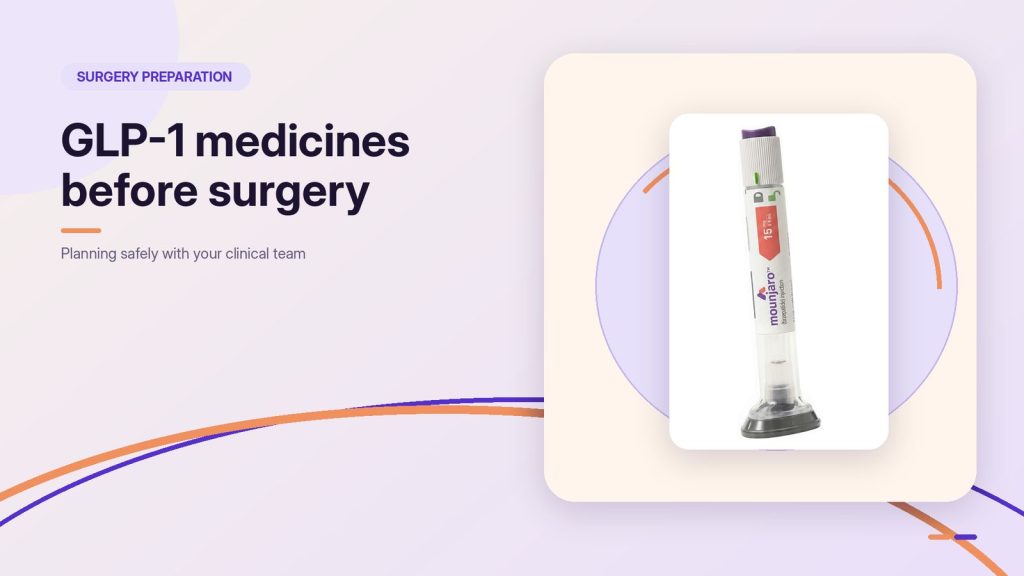
Current UK and US anaesthesia guidance states that most patients can continue Mounjaro, Wegovy or Ozempic before planned surgery. We recommend telling your surgeon and anaesthetist that you take a GLP-1 medication. UK and US guidance is not automatically a UAE hospital protocol, so your own anaesthetist’s instructions come first. Your surgical team will decide whether you should continue treatment, pause it or follow special eating instructions before the procedure.
- A UK consensus statement from eight organisations, including the Royal College of Anaesthetists, recommends that patients continue GLP-1 medications throughout the period around planned surgery.
- The 2024 US multi-society guidance states that most patients can continue GLP-1 medications, and advises a liquid diet for 24 hours before a procedure for those at the highest risk.
- The prescribing information for Mounjaro warns of rare reports of pulmonary aspiration, when stomach contents enter the lungs, during general anaesthesia or deep sedation.
- The same label states that the available data cannot show whether stopping the medication or changing fasting instructions reduces this risk.
- The American Society of Anesthesiologists advises that surgery should wait until symptoms such as nausea, vomiting or stomach pain have gone.
- If you take a GLP-1 medication for type 2 diabetes, stopping it before surgery can worsen blood sugar control, so your endocrinologist and surgical team will agree a plan in advance.
- If your surgical team asks you to pause treatment, your endocrinologist will plan when and how to restart it after the procedure.
Do you need to stop Mounjaro, Wegovy or Ozempic before surgery?
Current guidance does not ask most patients taking Mounjaro, Wegovy or Ozempic to stop before planned surgery. A UK consensus statement published in the journal Anaesthesia in January 2025 states that patients should keep taking their GLP-1 medication throughout the peri-operative period. It also asks patients and clinicians to follow the recommended fasting guidelines.
The statement was produced by eight UK organisations, including the Royal College of Anaesthetists, the Association of Anaesthetists and the Centre for Perioperative Care.
In the US, guidance issued in October 2024 by the American Society of Anesthesiologists (ASA) and four other societies states that most patients should continue their GLP-1 medication before elective surgery. It advises patients at the highest risk to follow a liquid diet for 24 hours before the procedure.
Your surgeon and anaesthetist will decide what applies to you. Their decision can depend on your dose, any symptoms you have and the type of anaesthetic. UK and US guidance is not automatically the protocol of a hospital in the UAE. We recommend following your own anaesthetist’s instructions, particularly if you have nausea, are increasing your dose or are having deep sedation.
Why GLP-1 medications matter for anaesthesia
GLP-1 medications slow the rate at which the stomach empties. Before a general anaesthetic or deep sedation, an empty stomach lowers the risk of stomach contents entering the lungs, which is called pulmonary aspiration.
The prescribing information for Mounjaro reports rare cases of pulmonary aspiration in patients taking GLP-1 medications who still had food in the stomach despite following fasting instructions. It also states that there is not enough evidence to say whether a longer fast or a temporary pause in treatment would lower the risk. The Wegovy label carries the same warning.
The American Society of Anesthesiologists describes aspiration as dangerous and potentially life-threatening.
What to tell your surgeon and anaesthetist
We recommend telling your surgeon and anaesthetist about your GLP-1 medication as soon as an operation or procedure is planned. The NHS advises telling the healthcare professional if you are due to have a general anaesthetic or a sedative for an operation or dental procedure. The Medicines and Healthcare products Regulatory Agency (MHRA) also advises telling the anaesthetist.
The details your team will need include:
- the name of your medication and your current dose
- the day you took your last dose
- whether you started treatment or increased your dose recently
- any nausea, vomiting, stomach pain, bloating or constipation
- whether you take it for type 2 diabetes, and which other diabetes medications you take
Your endocrinologist can share a summary of your treatment with your surgical team if it helps.
The days before your procedure
Your surgical team will give you fasting instructions before the procedure. Some patients are also asked to follow a liquid diet for the 24 hours beforehand. The ASA advises this for patients on a higher dose, and notes that anyone may be asked to avoid solid food for 24 hours.
The UK consensus statement notes that slower stomach emptying may be particularly relevant soon after starting treatment or after a dose increase. The US guidance describes this escalation phase, which it puts at typically four to eight weeks, as a time of higher risk. If an operation is planned, your endocrinologist can discuss whether to hold a dose increase until after it.
If you have nausea, vomiting, stomach pain or constipation in the days before your procedure, tell your surgical team. The ASA’s advice to patients is that surgery should be postponed until these symptoms have settled. These are also common side effects of GLP-1 medications, as our page on the side effects of Mounjaro explains.
If you take the medication for type 2 diabetes
For patients with type 2 diabetes, a pause in a GLP-1 medication such as Ozempic can worsen blood sugar control. The 2024 US guidance notes that withholding these medications can raise blood sugar in people with diabetes, and that this risk has to be weighed against the risk of aspiration.
In its patient leaflet, the North Tees and Hartlepool NHS Foundation Trust explains that high blood sugar around an operation can slow recovery and increase the risk of infection.
Your other diabetes medications may also need adjusting while you fast, particularly insulin or a sulfonylurea, which can cause low blood sugar. Your endocrinologist and your surgical team will agree a plan for all your diabetes medications before the procedure.
Restarting treatment after your procedure
If you continued your medication before the procedure, your endocrinologist will advise whether to keep to your usual dose day while you recover. After a pause, the timing and dose of your first injection depend on how long the gap lasted and how you are recovering. Your endocrinologist will plan this with you.
For Wegovy, the label’s options after two or more missed doses are to resume as scheduled or to start the dose escalation again. For Foundayo, the label advises restarting the dose escalation at a lower dose after 7 or more missed days. Each dose step for Mounjaro is described in our Mounjaro dosage guide.
Frequently asked questions
Do I need to stop Mounjaro before an endoscopy?
We recommend telling the team carrying out the endoscopy that you take Mounjaro and when you took your last dose. The 2024 US guidance was issued jointly with gastroenterology and endoscopic surgery societies, and applies to procedures as well as surgery. The UK consensus statement notes that its recommendations may be less applicable to endoscopy. The team will give you instructions on your diet and your dose before the procedure.
What if I need surgery at short notice?
The surgical team and the anaesthetist will need details of your GLP-1 medication, including the day of your last dose. The UK consensus statement notes that its recommendations may be less applicable outside planned surgery, so the anaesthetist will decide how to proceed.
Do I need to stop Foundayo before surgery?
Foundayo is a once-daily tablet. The Foundayo prescribing information carries the same warning about pulmonary aspiration as the injection labels. It asks patients to inform their healthcare providers before any planned surgery or procedure. The UK and US guidance on GLP-1 medications was published before Foundayo was approved in 2026. Guidance written for the older GLP-1 medications may not address Foundayo by name, and the same plan before surgery has not been formally validated for every product. Your surgical team will advise you on your doses.
Can I stop Mounjaro for two weeks and then restart?
Neither the current UK guidance nor the US guidance sets a two-week pause for most patients. A pause of any length should be agreed with your surgical team and your endocrinologist. The missed-dose instructions in the Mounjaro prescribing information describe a single missed dose, so your endocrinologist will advise how to restart after a longer gap.
Patients should not decide by themselves to start a GLP-1 medication. A doctor’s review is critical to ensure the treatment is safe and appropriate for the individual.
Monthly follow-up appointments can be held in person at the clinic or online.
At our Dubai clinic, your endocrinologist will assess you, review your medication and dose, and plan your treatment around your procedure with you. You can book a weight loss consultation on +971 4 285 3885 or send us a message on WhatsApp.
