

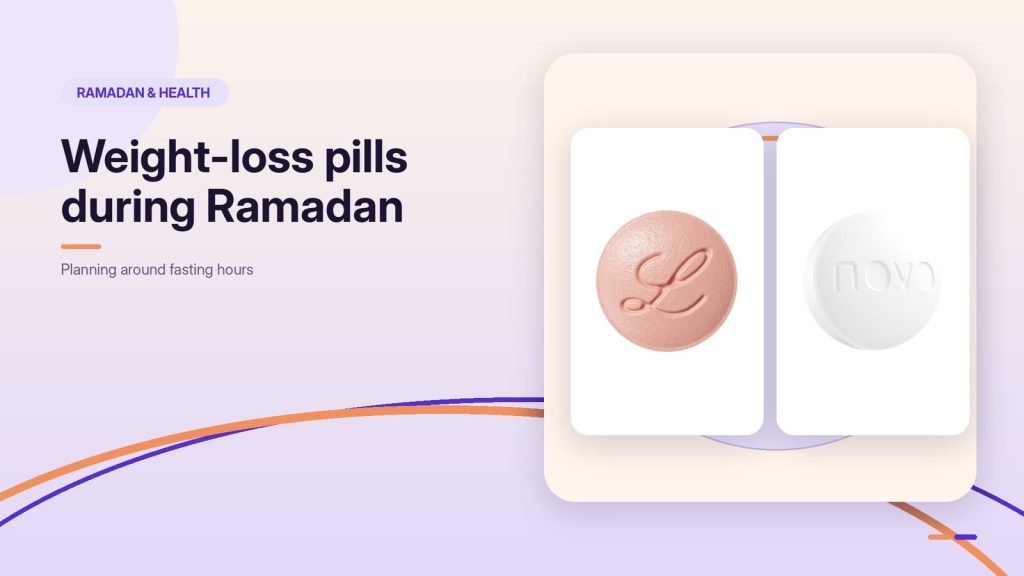
Weight loss pills can often be planned around Ramadan fasting with your endocrinologist. Foundayo can be taken with or without food, at iftar or at suhoor. The Wegovy pill needs an empty stomach, and its US label asks for a morning dose, so its Ramadan timing needs your endocrinologist’s advice. We recommend taking your tablet at a consistent time each day where possible. People with diabetes who take insulin or a sulfonylurea need an individual fasting plan.
- The Wegovy pill is swallowed with up to 120 mL of plain water on an empty stomach, followed by a 30-minute wait before food, drink or other medications.
- The UK product information asks for a fast of at least eight hours before each Wegovy pill, while the US prescribing information asks for it on waking, in the morning, which can conflict with taking it at iftar.
- In 2022, diabetes specialists from the UAE and other countries recommended that oral semaglutide for type 2 diabetes be taken at iftar, with eating delayed by 30 minutes.
- Foundayo has no food or water restriction, and Eli Lilly describes it as suitable for any time of day.
- The risk of low blood sugar can rise when a GLP-1 medication is combined with insulin or a sulfonylurea, and fasting can add to that risk.
- Persistent vomiting or diarrhoea during a fast needs medical advice, as both can lead to dehydration.
- Questions about religious exemptions from fasting are best discussed with a religious scholar, while your endocrinologist advises on the medical side.
Can you take the Wegovy pill while fasting in Ramadan?
The Wegovy pill (oral semaglutide) is taken once a day on an empty stomach. The UK product information asks for at least eight hours without food beforehand, up to half a cup (120 mL) of water, and a wait of at least 30 minutes before eating, drinking or taking other medications.
For people who fast, the tablet therefore needs to fit into the hours between iftar and suhoor. By iftar, a day of fasting provides the empty stomach that the UK product information asks for. The US prescribing information asks for the Wegovy pill to be taken on waking, in the morning, which can conflict with taking it at iftar. The 2022 recommendation to take oral semaglutide at iftar was written for type 2 diabetes, so the timing of the Wegovy pill during Ramadan needs to be agreed with your endocrinologist against the product information that applies in the UAE.
In 2022, a group of diabetes specialists from the UAE and other countries published recommendations for oral semaglutide during Ramadan, written for people with type 2 diabetes who take Rybelsus. They recommended taking the tablet when breaking the fast at iftar, then waiting 30 minutes, including the Maghrib prayer, before eating.
These recommendations were based on expert opinion, as no Ramadan studies of oral semaglutide were available. The meeting that produced them was funded by Novo Nordisk, the manufacturer of semaglutide.
Taking the Wegovy pill at suhoor is also possible if you have not eaten for at least eight hours beforehand, which can be difficult after an evening meal. The US prescribing information asks for the tablet to be taken in the morning. Your endocrinologist will discuss which timing is appropriate for you, and our Wegovy pill dosage guide sets out every rule for taking it.
Taking Foundayo during Ramadan
The US prescribing information for Foundayo allows Foundayo to be taken once a day, with or without food. Eli Lilly, the manufacturer, states that it can be taken at any time of day, without restrictions on food and water.
During Ramadan, Foundayo can therefore be taken at iftar or at suhoor. We recommend choosing one of these times and keeping to it throughout the month, as a fixed routine can make missed doses less likely.
If you miss a dose, the prescribing information advises taking it as soon as possible, without doubling the next one. Our Foundayo dosage guide explains the other dose rules.
Other medications and the timing of your pill
With the Wegovy pill, other oral medications are taken after the 30-minute wait, because food, drink and other tablets can reduce how much semaglutide is absorbed. Foundayo has no such restriction.
If you take levothyroxine for an underactive thyroid, the 2022 recommendations describe bedtime dosing as an option, with closer monitoring of thyroid levels. Your endocrinologist will advise on the timing of each of your medications during Ramadan.
Diabetes, low blood sugar and fasting on a GLP-1 pill
For people with type 2 diabetes, fasting can increase the risk of low blood sugar. The EPIDIAR study, a large international study of people with diabetes who fasted, found that severe low blood sugar requiring hospital care was 7.5 times more frequent during Ramadan in people with type 2 diabetes.
The prescribing information for both pills states that the risk of low blood sugar can rise when they are taken with insulin or a sulfonylurea. Your endocrinologist may lower the dose of those medications before or during Ramadan.
The International Diabetes Federation and the Diabetes and Ramadan International Alliance publish practical guidelines on fasting with diabetes. The guidelines’ lead author is based at Dubai Hospital.
Side effects and dehydration during the fast
Nausea, vomiting and diarrhoea are among the most common side effects of both pills. The UK product information for the Wegovy pill warns that vomiting and diarrhoea can lead to dehydration, which in rare cases can affect how well the kidneys work.
Seek medical advice immediately if you keep vomiting or cannot keep fluids down.
Side effects such as nausea or constipation can be particularly pronounced in the first few days at a new dose. They often improve as your body adjusts, although some symptoms last longer. For this reason, your endocrinologist may discuss the timing of any dose increase before Ramadan. Our pages on Wegovy pill side effects and Foundayo side effects describe each side effect.
Planning your treatment before Ramadan
We recommend booking a review with your endocrinologist a few weeks before Ramadan. Your endocrinologist will review your dose, the timing of your tablet and your other medications, and discuss whether fasting is medically appropriate for you.
For questions about exemptions from fasting on religious grounds, we recommend speaking to a religious scholar.
If you take a weekly injection, our article on weight loss injections during Ramadan covers its timing. Our guide to Ramadan and GLP-1 therapy covers medication adjustments more broadly.
Eating at iftar and suhoor on a weight loss pill
A smaller appetite on a GLP-1 medication can make it harder to eat enough protein and drink enough fluid between iftar and suhoor. Endocare’s lifestyle coaches can adapt your meal plan to the fasting hours, with a focus on protein, fibre and fluids.
Our guide to losing weight during Ramadan has practical ideas for suhoor and iftar.
Frequently asked questions
Does the Wegovy pill have to be taken in the morning during Ramadan?
Not necessarily. The US prescribing information asks for a morning dose, while the UK product information sets no time of day and asks for at least eight hours without food beforehand. Your endocrinologist will agree the timing with you against the product information that applies in the UAE.
Can I take Foundayo at suhoor?
Yes. Foundayo can be taken with or without food, so both suhoor and iftar are possible. Keeping to the same time each day can help you avoid missing a dose.
Should I stop my weight loss pill during Ramadan?
Not without speaking to your endocrinologist first. Your endocrinologist can discuss whether to adjust the timing or the dose for the month. Stopping and restarting can affect the dose steps, so we recommend agreeing on any change before Ramadan begins.
Is it safe to fast with type 2 diabetes while taking a GLP-1 pill?
It depends on your diabetes, your other medications and your overall health. The International Diabetes Federation and Diabetes and Ramadan International Alliance (IDF-DAR) guidelines help doctors assess the risks of fasting for each person. We recommend a review with your endocrinologist before Ramadan, particularly if you take insulin or a sulfonylurea.
Patients should not decide by themselves to start a GLP-1 medication. A doctor’s review is critical to ensure the treatment is safe and appropriate for the individual.
At our Dubai clinic, your endocrinologist will assess you, plan the timing of your medication and review your progress during and after Ramadan.
Monthly follow-up appointments can be held in person at the clinic or online. We recommend the first consultation in person, as it includes a physical examination and body composition analysis.
You can book a weight loss consultation on +971 4 285 3885 or send us a message on WhatsApp.
